Kajabi vs WordPress: Which Platform Is Actually Better for Coaches and Creators?
By Chrisianie Pacheco
Chrisianie Pacheco is the founder of Fav Studio, a creative studio specializing in Kajabi design, creator websites and third-party Kajabi templates.
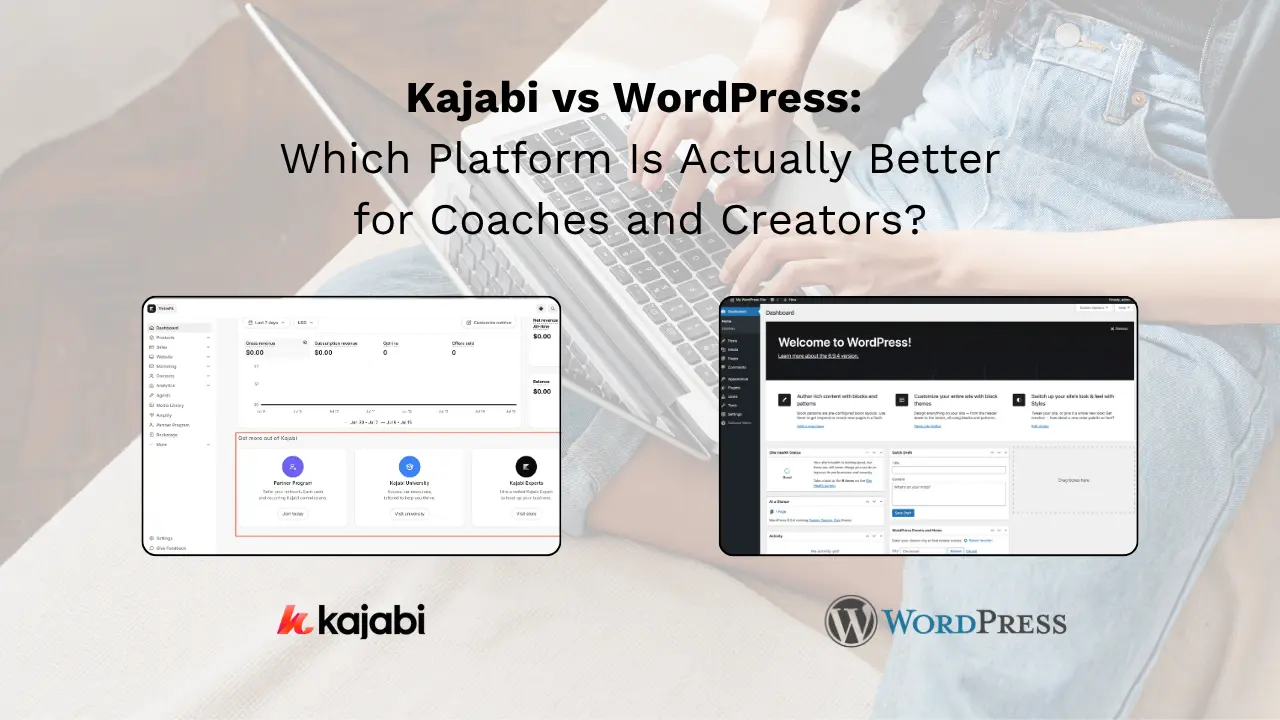
The Kajabi vs WordPress debate comes up constantly in creator and coaching communities, and honestly, most of the comparisons out there are either too technical, too biased, or too surface-level to actually help you make a smart decision.
Here's the thing: both platforms can build you a beautiful website. Both can host your content. Both have creators swearing by them. But they are fundamentally different tools built for fundamentally different types of businesses, and choosing the wrong one doesn't just cost you money. It costs you time, momentum, and the kind of focus you need when you're building something serious.
This breakdown is going to cut through the noise. No technical jargon, no affiliate-driven bias. Just a clear, honest look at what each platform actually does, who it's built for, and how to know which one fits where your business is right now.
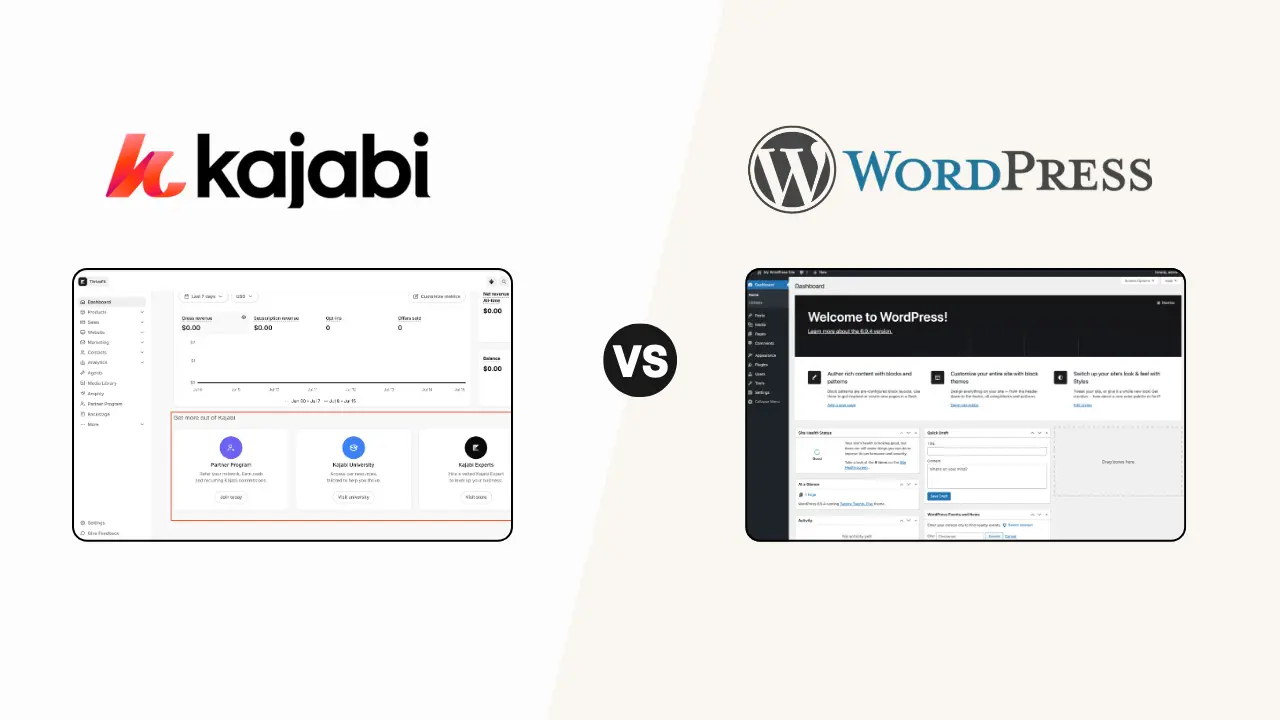
The Real Difference Between Kajabi and WordPress Nobody Talks About
Most Kajabi vs WordPress comparisons start with features. Kajabi has this, WordPress has that. But that framing misses the more important question: what kind of business owner are you, and what do you actually need your platform to do?
Kajabi is a closed, all-in-one ecosystem. It was built specifically for digital product businesses, coaches, course creators, and membership site owners who want everything, their website, courses, email, funnels, community, and checkout, living in one place without needing a developer to hold it together.
WordPress is an open-source content management system. It was built for the web at large, which means it can technically do almost anything, but only if you're willing to assemble the right combination of plugins, themes, hosting, and integrations to make it work the way you need it to.
One is a furnished apartment. The other is an empty building with unlimited renovation potential. Neither is wrong. But they suit very different people.
What Kajabi Gets Right That WordPress Simply Cannot Match Out of the Box
When coaches and creators ask about the best platform for online courses, Kajabi consistently comes out on top for one reason: it was built for exactly this use case, and it shows in every part of the experience.
Everything Lives in One Place and Actually Talks to Each Other
This sounds like a small thing until you've spent an afternoon troubleshooting why your email platform isn't syncing with your course platform, which isn't talking to your checkout tool, which just broke because a plugin updated overnight.
On Kajabi, your email sequences know what courses someone has purchased. Your funnels respond to where someone is in your ecosystem. Your analytics show you the full picture across every touchpoint. That level of native connectivity doesn't exist on WordPress without a significant investment in plugins, developers, and ongoing maintenance.
For a coach or creator who wants to spend their time building their business rather than managing their tech stack, that integration is worth the price of admission on its own.
The Course and Membership Experience Is Built to Feel Premium
Kajabi's student experience is clean, intuitive, and designed to make your offer look high-end without you having to do any custom development. Progress tracking, drip content, certificates, assessments, community access, all of it works beautifully out of the box.
On WordPress, replicating that experience requires a learning management system plugin like LearnDash or LifterLMS, a membership plugin, a payment processor, and often a page builder on top of all of that. It can absolutely be done, but it's a project, not a setup.
You Don't Need a Developer to Launch or Maintain It
For most coaches and creators, this is the deciding factor. Kajabi was designed to be operated by business owners, not developers. Updates happen automatically. Security is handled. Hosting is included. You can build a landing page, set up an email sequence, and launch a course in a single afternoon without touching a line of code.
WordPress gives you far more flexibility, but that flexibility comes with responsibility. Plugins need updating. Hosting needs managing. Security needs monitoring. If something breaks, you either fix it yourself or hire someone who can.
Where WordPress Wins and When It Actually Makes More Sense Than Kajabi
A fair Kajabi comparison has to acknowledge what WordPress does genuinely better, because for certain business models and certain types of creators, WordPress is the smarter choice.
WordPress for SEO and Long-Term Content Strategy
If content marketing and SEO are the primary engine of your business growth, WordPress has a meaningful edge. The platform was built for publishing, and it shows. Plugins like Yoast SEO give you granular control over every technical SEO element. Your URL structures, your schema markup, your site speed optimization, all of it is configurable at a level Kajabi simply doesn't offer.
For a business whose main growth channel is organic search, that depth matters. WordPress for coaches and creators who are building a content-first business with thousands of articles and a serious SEO strategy is a legitimate case for choosing the platform.
WordPress Gives You Unlimited Design and Functionality Freedom
If you have a very specific vision for your website that goes beyond what any template or page builder can produce, WordPress with a custom theme or a builder like Elementor or Webflow-adjacent custom development gives you total creative control.
Kajabi's design system is capable, and in the right hands it produces genuinely premium results. But it has a ceiling. WordPress, by contrast, can be built into virtually anything with the right development resource behind it.
WordPress Can Be More Cost-Effective at Scale for the Right Business Model
Kajabi's pricing is a flat monthly subscription regardless of how much traffic you get or how many pages you have. WordPress hosting, by contrast, scales with your actual needs. For a large content site with a complex architecture and a dedicated development team, WordPress can be more economical at significant scale.
For most individual coaches and creators, this calculation doesn't apply. But for media companies, large education brands, or businesses with complex custom requirements, it's a real consideration.
Kajabi or WordPress: The Decision Framework That Actually Helps You Choose
Instead of a feature list, here's the question framework that cuts to the right answer faster than any comparison chart.
Choose Kajabi If...
You are building a digital product business, coaching practice, course platform, or membership site and you want everything in one place.
You value simplicity, speed to market, and a polished student experience over total customization.
You don't have a developer on your team and you don't want to need one.
You want your email, funnels, checkout, and course delivery to work together natively without you having to manage the connections.
This is the profile of the vast majority of coaches and creators who come to Fav Studio for help building on Kajabi, and it's the profile Kajabi was designed for.
Choose WordPress If...
Your primary business model is content and advertising revenue rather than digital products.
You need total design freedom and you have, or are willing to hire, a developer to build and maintain your site.
SEO is your core growth channel and you need the deepest possible technical SEO control.
You're building something that goes significantly beyond a standard course, coaching, or membership business, something with custom functionality that Kajabi's ecosystem simply doesn't support.
What About Using Both?
Some businesses run a WordPress site for their content and SEO strategy while using Kajabi for their course and membership delivery. This hybrid approach works, but it adds complexity. You're managing two platforms, two tech stacks, and two sets of potential issues. It's a viable setup for an established business with the team to support it. For most individual creators and coaches, it's more infrastructure than the business needs.
What Real Kajabi Sites Look Like When They're Built With Strategy
One of the most common hesitations creators have about Kajabi is the design ceiling. They've seen too many Kajabi sites that look exactly like Kajabi sites, template-y, generic, and clearly built from the same starting point as everyone else on the platform.
That's a strategy problem, not a platform problem.
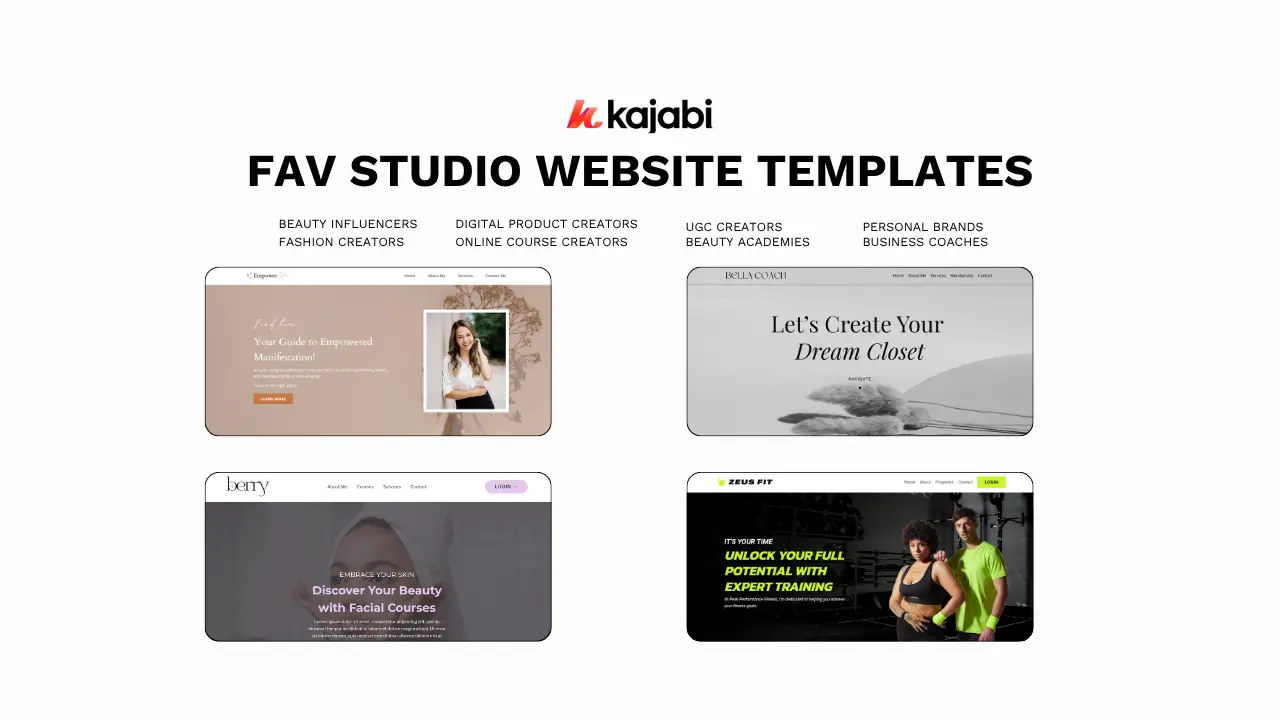
When Kajabi is built with real brand strategy, custom design direction, and a clear conversion architecture behind it, the results look nothing like a standard Kajabi template. The Kajabi sites we build at Fav Studio, for coaching brands, online academies, beauty educators, and lifestyle creators, are regularly mistaken for fully custom-developed websites. The platform is capable of far more than most people see in the wild.
The difference isn't the platform. It's the thinking that happens before anyone opens the page builder.
FAQ: Kajabi vs WordPress
Is Kajabi Better Than WordPress for Online Courses?
For most coaches and course creators, yes. Kajabi was built specifically for digital product businesses and the course delivery experience, the student dashboard, the drip content, the progress tracking, all of it works natively without additional plugins or development. WordPress can replicate this functionality, but it requires assembling multiple plugins and maintaining them over time. If launching and running courses is the core of your business, Kajabi is the more practical and polished choice.
Can WordPress Do Everything Kajabi Does?
Technically, yes, with the right combination of plugins and development work. Practically, for most individual creators and coaches, building the equivalent of Kajabi's native ecosystem on WordPress requires significant time, money, and technical expertise. The better question isn't whether WordPress can do it, it's whether building and maintaining that system is the best use of your resources.
Is Kajabi Worth the Higher Price Compared to WordPress?
WordPress itself is free, but the total cost of a properly built WordPress site for a course or coaching business, including hosting, premium plugins, security, maintenance, and development, often lands closer to Kajabi's price than most people expect. When you factor in the time saved on tech management and the native integration between Kajabi's tools, the price gap narrows significantly for most business models.
Which Platform Is Better for SEO, Kajabi or WordPress?
WordPress has a deeper SEO toolset, particularly for large content sites with complex technical SEO needs. For most coaches and creators publishing regular blog content and optimizing their sales pages, Kajabi's built-in SEO features are more than sufficient. The biggest SEO factor for most creator businesses isn't the platform, it's the consistency and quality of the content being published on it.
Can I Move From WordPress to Kajabi Later?
Yes, migration from WordPress to Kajabi is possible and something many creators do as their business grows and they want to consolidate their tools. Course content, email lists, and website pages can all be moved across. The process takes planning but it's entirely manageable, and many creators find that making the switch earlier rather than later saves them from compounding tech debt down the line.
The Platform Decision Is Step One. What You Build on It Is Everything Else.
Choosing between Kajabi and WordPress is a meaningful decision, but it's not the hardest one you'll make building your digital business. The harder work is what comes after: the positioning, the design, the offer architecture, the content strategy, and the conversion system that turns your platform into something that actually generates revenue.
The coaches and creators who get the most out of Kajabi aren't the ones who chose it because of a comparison article. They're the ones who chose it with intention, built on it with strategy, and treated their platform as a business asset rather than a technical checkbox.
That's the difference between a website that exists and one that works.
At Fav Studio, we help coaches, creators, and digital brands build Kajabi sites and content systems that are designed to convert from day one. If you're ready to stop figuring out the tech and start building something that grows, let's talk about what that looks like for your business. For more about our approach, explore our case studies or learn about us.
Book a strategy session, let's build your Kajabi site the right way. Start a project with Fav Studio.